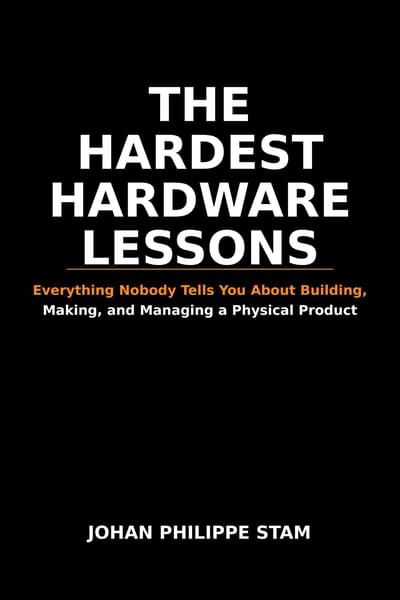
The Hardest Hardware Lessons: What Nobody Tells You About Building a Physical Product
If you've ever stood in a factory at 2am, wondering why the product you spent two years building isn't working the way it should, you already know something important: hardware is different.
Not harder than software in every dimension. Different. Harder in ways that the methodology documents and university courses don't fully prepare you for. Harder in ways that only become visible once you're standing inside the problem.
I wrote The Hardest Hardware Lessons because those ways deserve to be named - specifically, honestly, and before they cost you.
There are two versions of how hardware gets built
The published version is clean.
It describes development phases in logical sequence: Prototyping, EVT, DVT, PVT, mass production. With defined inputs and outputs, clear milestones, and the implication that a team which follows the process correctly will produce a product that works, ships on time, and performs as intended.
The unpublished version is what actually happens.
It includes
- The certification test that failed because a PCB layout decision made six months earlier had never been simulated for EMC performance.
- The tooling modification that cost €80,000 because a mechanical design was committed to hard tooling before a thermal problem was resolved.
- The mass production yield problem that consumed six months of engineering capacity because a process that wasn't properly validated in PVT turned out to be producing systematic defects at a rate that only became visible at volume.
These aren't edge cases. They're the pattern - repeated across hardware programs, across industries, across company sizes. The specific product changes. The structure of the mistake doesn't.
Why smart teams keep making expensive mistakes
The hardware development process - with its gates, its validation phases, its formal reviews - exists for one reason: to find problems at the current cost level before they become problems at the next cost level.
- A design flaw found in prototyping costs thousands to fix.
- The same flaw found after hard tooling is committed costs hundreds of thousands.
- Found in mass production, it can cost millions. Plus a field recall. Plus the reputational damage that comes with it.
The cost ratio between early discovery and late discovery of the same problem is not 10:1. It's more often 100:1.
That logic is simple. So why do teams consistently move forward before they're ready?
Pressure. Pressure from investors who were told the product would ship six months ago. Pressure from customers who pre-ordered and want updates. Pressure from competitors who appear to be moving faster. Pressure from the team itself - engineers who are tired of the current phase and ready to move on. This pressure is real and understandable. It is also, when it causes a team to skip a gate or paper over an open issue, one of the most reliable mechanisms for creating exactly the expensive downstream problem the process was designed to prevent.
The hardest hardware lessons aren't the technically complex ones. Those are learnable - from datasheets, from mentors, from iteration. The hardest lessons are about discipline: the specific moments when the rational decision is to hold the gate, and the pressure to move forward is at its highest. These are the moments that determine, more than any technical decision, whether a hardware product gets built well or expensively.
What the book covers
The Hardest Hardware Lessons follows a hardware product's full life - from the first bench prototype to the last unit shipped before end-of-life.
It covers development in depth: prototyping, EVT, DVT, and PVT, with the common failure modes named and the decision frameworks made explicit. It covers the factory floor - how manufacturing actually works, how to evaluate a manufacturing partner, and what experienced operators know that first-time founders typically don't. It covers supply chain - how component shortages happen, how to manage single-source risk, and what a resilient supply chain actually looks like in practice. It covers mass production operations, quality systems, engineering changes, and field failures. And it covers the product's commercial life - cost reduction, versioning, sustaining engineering, and how to know when it's time to retire a product.
Each section ends with a lesson - a direct, specific statement of the most important thing that section has to teach, framed not as a principle but as the mistake most teams make and the cost of making it. These are the things that experienced hardware practitioners know. That first-time teams consistently discover the expensive way.
Who it's for
This book is for founders who have committed to building something physical and are discovering what that commitment actually means. For engineers navigating the interfaces between their discipline and every other. For operations and supply chain professionals managing the systems that keep production running. And for investors and executives who need to understand hardware businesses deeply enough to ask the right questions and recognise the right answers.
It is not a textbook. It is not a methodology document. It is the unpublished version of how hardware gets built, written down - so you can learn from it before it costs you.
The first lesson of hardware development is also the last: Every shortcut you take today is a cost you will pay downstream, at a higher rate, under worse conditions.
This book is your preparation for the pressure that will try to make you take those shortcuts anyway.
 Get the book here